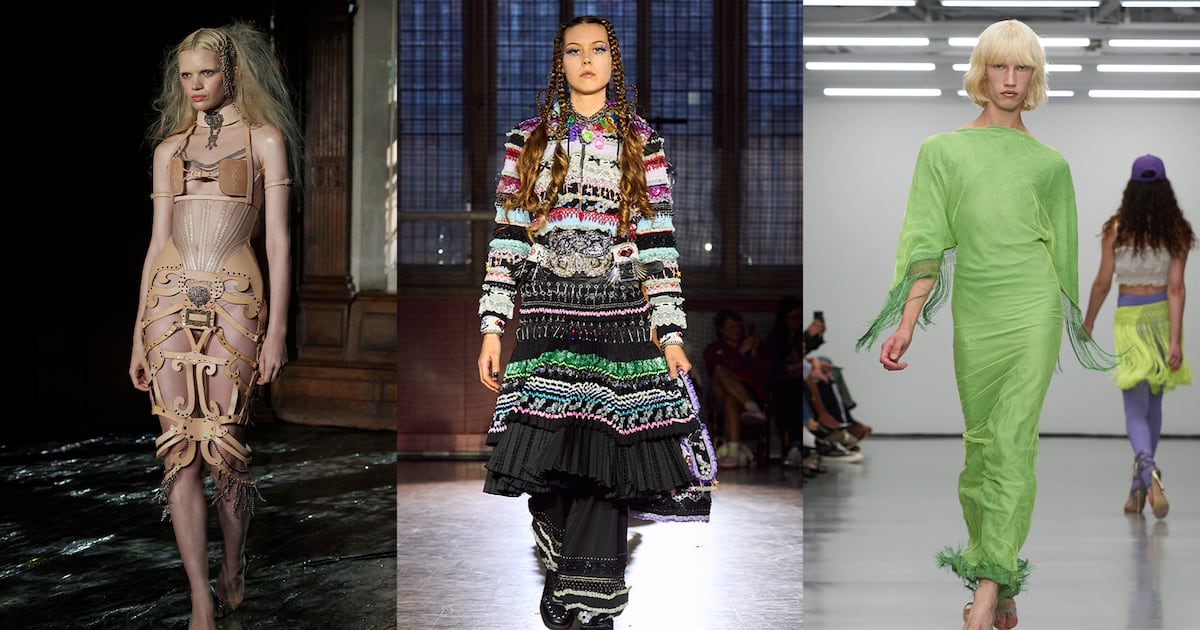

LONDON — Did the London shows feel different this season?
There was a whiff of change in the air as the British Fashion Council held its first fashion week under new CEO Laura Weir, who has eliminated the fees that designers had to pay to show on the official schedule and increased funding to bring in international press.
The return of H&M, which staged a three-part show on Thursday night, made for an energetic unofficial opener to the week. But what was most palpable was a kind of collective will among industry insiders to cheer London on as it attempts to open a new chapter for its fashion week despite the market challenges facing the emerging designers who are its raison d’etre.
“As an industry we can be guilty of talking ourselves down and not recognising the greatness that’s in front of us,” said Weir. “Having not done the shows for a number of years, coming back this season I’ve been reminded there is so much to love about London.”
Resilience was a throughline, especially among the designers celebrating significant anniversaries this season. Roksanda Ilincic has notched up twenty years in business and the evolution of her sculptural pieces — richer in palette and larger in scope, with a fleshed out tailoring offering — shows how far she’s come. Alongside new, Barbara Hepworth-inspired dresses, she revived a number of archival pieces going all the way back to her early days at Lulu Kennedy’s Fashion East.
Incidentally, Kennedy’s fashion incubator turned 25 this year. “Us lot don’t stop” was the slogan that titled an ICA exhibition featuring special commissions from past Fashion East alums, from Simone Rocha to Craig Green. Amongst its current crop, Jacek Gleba’s unusual take on balletcore stood out.
Erdem Moralioglu’s label will turn 20 next year. He’s never short of unusual muses and this time it was 19th century French surrealist psychic Héléne Smith, who imagined herself in past lives as Marie Antoinette, an Indian princess and a Martian. Set against the British Museum’s grey stone, a passage of silk dresses in neon pink and acid green was particularly potent. Throw in Rococo and a Martian alphabet as an embroidery motif and you have yourself a wild mix that Moriaglu thoroughly mastered.
Conner Ives got back to form with unexpected pops of neon, amped up by Indie Sleaze era Uffie. You can hardly detect that Ives upcycles secondhand garments when they’re so brightly hued. Harris Reed taking showgoers to the St Pancras Hotel where The Spice Girls’ “Wannabe” was filmed was another pop moment. Reed hasn’t strayed from his wallpaper-derived silk corsets and purposely unwieldy petticoats but he knows his audience. Similarly Richard Quinn’s heaving gowns catered directly to clients.
It was some of London’s more idiosyncratic female voices that stood out the most. Simone Rocha’s disgruntled debutantes, rebelling against their mothers, were shrouded in plastic and giant blooms with bouncing crinoline skirts as they walked through the magnificent Mansion House. There was an on-display nature to the pieces, a theme Rocha has explored before: the need to perform in today’s world troubles Rocha, but there’s nothing performative about clothes that rouse emotion.
Hundreds of fans queued to take in Dilara Findikoglu’s work at a watch party near her show. Some also tried to crash the catwalk event itself, which didn’t begin until an hour after the appointed hour. It felt the days of London Fashion Week past, with its late starts and messy doors. But the wait was worth it when Findikoglu emancipated her ghostly women, trussed up in Victoriana garb and Turkish ornamentation. The designer revels in provocation — like a dress smeared with fake cherries — and it’s scintillating to watch.
Chopova Lowena also gathered up its tribe at a youth centre in West London to cheer on as carabiner skirts and fuzzy Harajuku knits went down the runway. The soundtrack of remixed cheer hype songs was the perfect complement to the duo’s inclusive new age cheerleaders. No ‘mean girls’ spirit here.
At the Barbican’s Conservatory, Susan Fang returned to London with her aerated pastel confections. Another returner to the London schedule was Priya Ahluwalia, who had romance on her mind and once again looked to her Asian and Black heritage to mine palette and pattern.
Newer names also impressed, like Johanna Parv who sent out a strident group of urban commuters in cycling gear, and Talia Byre, who designed with a simple premise: “Clothes I want to wear.”
The wealth of female designers kept on coming. Anna Jewsbury of Completedworks has hacked a clever way to showcase jewellery and this season, it was the turn of Jerry Hall to host the CWTV shopping channel. For those after something neater, Tove has you covered, with its brand of feminine minimalism. And if you want prim and proper, then Emilia Wickstead is your go-to.
“The one thing I tell young designers is that commercially they should do one thing very well,” said Judd Crane, executive buying and brand director at London-based department store chain Selfridges. “You can have a whole universe on a runway, but doing one thing well makes it commercially viable.”
Aaron Esh paints a singular image for his creatures of the night, who hang exclusively in E2 and are decked out in skinny fits reminiscent of Hedi Slimane. That’s canny as Slimane is currently without a house after his departure from Celine last year.
Oscar Ouwang has honed in on good knits and even though his brand is only a few seasons old, he’s already recognised the strength of a hero product, whilst experimenting with bird feathers on the runway. Harri has been trying to broaden away from the latex creations that made him a viral sensation, and his latest show at the Barbican was another such attempt. Meanwhile, Yaku Stapleton would rather world-build à la role player games: his characters favour naturalistic survival uniforms.
Paolo Carzana is unyielding when it comes to his work. His sculptural ensembles are natural-dyed in the most beautiful of hues, but turning the Welsh designer’s work — exalting as it is — into saleable product remains a challenge. His handcrafted creations are made for beauty’s sake alone and, in that sense, Carzana is an extreme case of what’s both strong and weak about London’s fashion scene.
Burberry’s closer to the week felt curiously obvious. Music and fashion as bedfellows? Daniel Lee aimed to hammer home that point with a festival-driven, ’60s/’70s-tinged collection of slickened outerwear, crochet and mirrored dresses and bashed up leathers. But easy to telegraph notions of Britishness are helping the house get back on its financial feet. Turn up the Black Sabbath then!